State Right to Work Laws and Employer-Provided Benefits
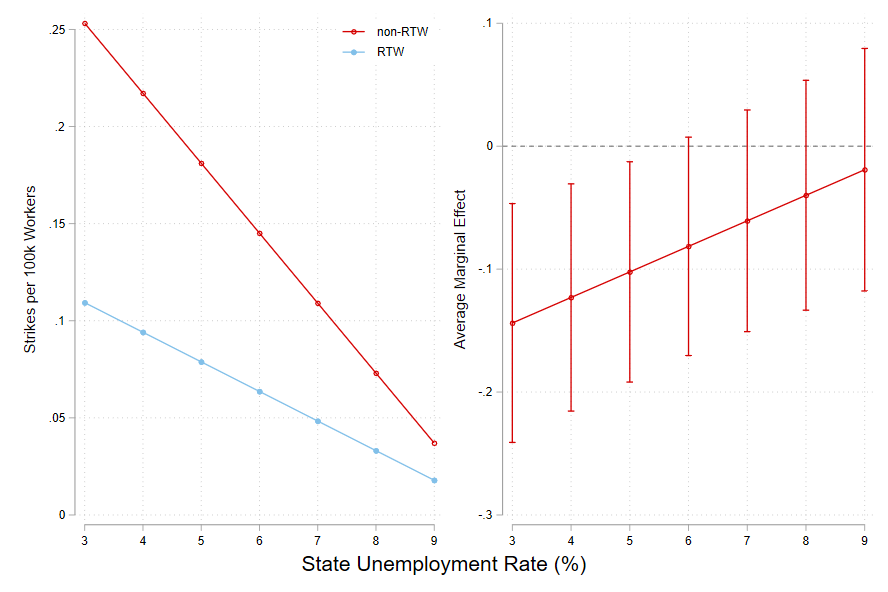
Employer-provided benefits add to total compensation and enhance economic security. Yet an increasing share of American workers lack access to employer-provided retirement and health insurance benefits, a trend that scholars link to labor union decline. I test whether state Right to Work (RTW) laws, which weaken associational worker power by targeting union security agreements, are associated with changes in employer-provided benefit coverage. Building on organizational inequality perspectives, I theorize a novel indirect impact whereby RTW conditions the returns to market-based structural worker power. I use two-way fixed effects models that leverage variation in the timing of RTW laws to estimate effects on employer-provided retirement and health insurance, relative to a control group of workers living in states that almost implemented RTW. Using pooled cross-sectional data from the 2001 to 2019 Current Population Surveys, I find that RTW weakened the inverse associations between state unemployment and retirement and health insurance benefits. Counterfactual analyses suggest declines in benefit coverage would have been lower or reversed had Indiana not implemented RTW. The findings suggest that attention to wages alone underestimate the consequences of RTW and highlight how different forms of worker power interact to shape compensation. This article was published in Social Forces.